
.png)




 PAY INVOICE
 Back
Back
 TWITTER
 FACEBOOK
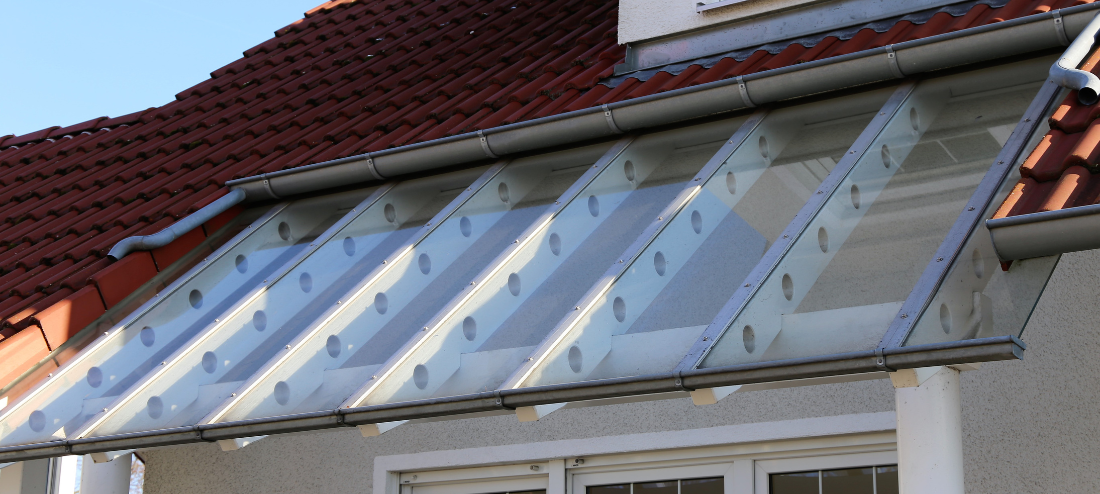
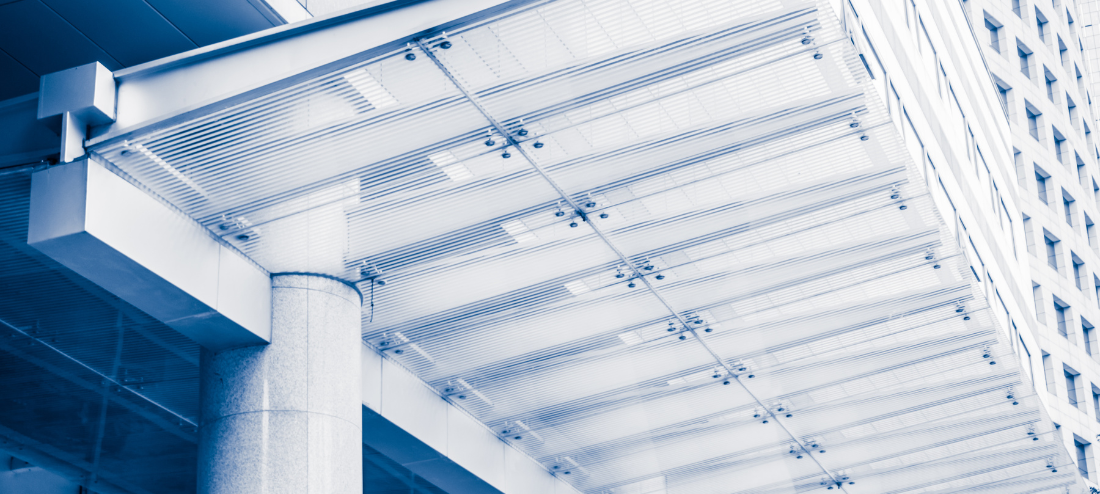
A glass door canopy looks elegant until the first serious storm hits. Then you discover whether it was designed by someone who understood wind loading or someone who just made it look good in the architect’s renders. The difference becomes obvious quickly – and expensively.
Door canopies occupy a particularly vulnerable position on buildings. They project outward into the wind flow, creating significant uplift forces. They’re typically positioned at building entrances where wind acceleration occurs. They’re often specified for aesthetic reasons with structural considerations treated as an afterthought. This combination creates structures that look lightweight and elegant but need to resist substantial forces.
The consequences of inadequate wind loading assessment aren’t just theoretical. Canopies tear away from facades during storms, creating safety hazards and expensive damage. Fixings fail because nobody calculated the actual forces involved. Glass shatters because the specification didn’t account for wind-induced deflection. These failures are preventable with appropriate structural design.
This isn’t about over-engineering every canopy to withstand hurricane-force winds. It’s about understanding the actual wind forces at your specific site, designing the structure to resist those forces with appropriate safety factors, and ensuring the installation can deliver the performance the calculations assume.
Why Canopies Are Particularly Vulnerable
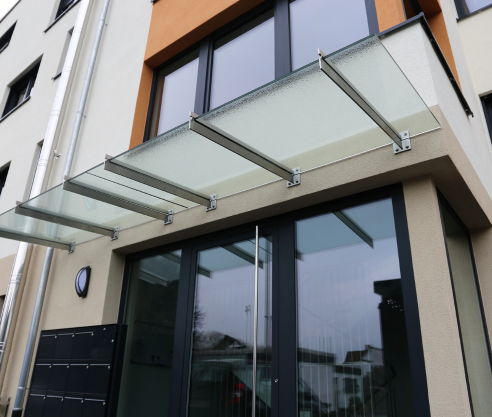
A canopy projecting from a building acts like a sail. Wind doesn’t just push against it – it creates uplift forces trying to tear it away from the facade, lateral forces trying to bend the supports, and dynamic effects from turbulence and gusting. All of these need consideration in structural design.
Understanding Wind Forces on Canopies
Wind interacts with canopy structures in ways that aren’t immediately obvious. It’s not simply a horizontal push – the forces are more complex and often more severe than basic intuition suggests.
Uplift vs. Lateral Forces
When wind hits a projecting canopy, it creates negative pressure on the upper surface – essentially suction trying to lift the canopy upward. This uplift force is often the critical design load, particularly for canopies with significant projection. A canopy projecting 1500mm experiences substantially higher uplift than one projecting 800mm, because the lever arm amplifying forces at the fixings increases.
Lateral forces push horizontally against the canopy and its support structure. These forces try to bend the support brackets and create shear loads at the fixing points. The magnitude depends on the canopy’s frontal area and the wind pressure.
The Canopy as a Sail
Projection distance matters enormously. A canopy projecting 2000mm from the facade experiences roughly four times the moment at the fixings compared to a 1000mm projection under the same wind load. This isn’t linear – small increases in projection create disproportionate increases in structural demand.
Turbulence around buildings creates dynamic effects. Wind doesn’t blow steadily – it gusts and swirls, creating fluctuating loads that can induce vibration and fatigue in structural components. Buildings create their own wind patterns, with acceleration at corners and around projections.
Pressure Zones and Failure Modes
Canopies experience both positive pressure (wind pushing) and negative pressure (suction). The underside might see positive pressure while the top surface experiences suction, creating a combined effect that tries to peel the canopy away from the building.
Common failure modes include:
- Fixings pulling out of the substrate
- Support brackets bending or fracturing
- Glass breaking due to excessive deflection
- Progressive failure where one component fails and overloads adjacent components
Wind Loading Standards and Calculations
Structural design for wind loading follows established standards, primarily BS EN 1991-1-4 (Eurocode 1: Actions on structures – Wind actions). These standards provide the framework for calculating wind forces based on location, exposure, and structure geometry.
-
Basic Wind Velocity and Terrain Categories
The UK is divided into zones with different basic wind velocities, ranging from around 21 m/s in sheltered inland areas to 28 m/s or more in exposed coastal and elevated locations. This basic wind velocity is then modified based on terrain category.
Terrain categories range from Category 0 (open sea, coastal areas) through Category IV (urban areas with dense buildings). A canopy in central London experiences different effective wind speeds than an identical canopy on an exposed coastal headland, even if the basic wind velocity is similar, because surrounding buildings provide sheltering.
-
Exposure Coefficients and Dynamic Pressure
Exposure coefficients account for height above ground and terrain roughness. A canopy at ground level experiences lower wind speeds than one at the 10th floor of a building, because wind velocity increases with height above ground.
Dynamic pressure – the pressure exerted by moving air – is calculated from wind velocity. The relationship is quadratic: double the wind speed and you quadruple the pressure. This is why small differences in site exposure create significant differences in structural demand.
For a simplified example, a site with 24 m/s wind velocity creates dynamic pressure around 350 Pa. Increase that to 28 m/s – not uncommon in exposed locations – and dynamic pressure jumps to about 475 Pa. That’s a 35% increase in force for a 17% increase in wind speed.
-
Force Coefficients for Canopy Configurations
Force coefficients translate dynamic pressure into actual forces on the structure. These coefficients depend on canopy geometry – a flat horizontal canopy has different coefficients than a pitched or curved canopy. The coefficients account for how wind flows around and over the structure.
For typical door canopies, uplift coefficients might range from -1.5 to -2.5 depending on configuration and position. That negative sign indicates suction. Combined with dynamic pressure, this gives you the actual uplift force per square metre.
-
When Detailed Analysis Is Needed
Simplified calculations work for straightforward installations in typical exposure conditions. Complex situations – unusual building geometry, extreme exposure, very large canopies, or critical applications – might need computational fluid dynamics (CFD) analysis to accurately predict wind loading. This level of analysis isn’t routine for standard door canopies, but it’s appropriate when conditions warrant it.
Site-Specific Factors That Affect Wind Loading
Two identical canopies can experience vastly different wind loads depending on where and how they’re installed. Site-specific factors often matter more than the canopy design itself.
Building Height and Position
Ground-level canopies in sheltered locations see relatively modest wind loads. The same canopy at the 15th floor of a tower block experiences significantly higher forces. Height above ground directly affects wind velocity and therefore loading.
Corner positions are particularly challenging. Wind accelerates around building corners, creating locally higher velocities and more complex flow patterns. A canopy at a corner entrance needs more robust design than one on a straight facade section.
Surrounding Structures and Wind Channelling
Urban environments with surrounding buildings provide sheltering that reduces wind loads. However, gaps between buildings can create wind channelling effects where velocity increases. A canopy positioned in a wind tunnel between two buildings might experience higher loads than exposure calculations for open terrain would suggest.
Coastal and Elevated Exposure
Coastal locations face higher basic wind velocities and less sheltering. Salt-laden wind also creates corrosion challenges that affect long-term structural integrity. Stainless steel specifications need to account for this aggressive environment.
Elevated sites – hilltops, cliff edges, exposed moorland – experience enhanced wind speeds due to topography. Local topography effects can increase wind speeds by 20-30% or more compared to flat terrain at the same location.
Recessed vs. Projecting Entrances
A canopy over a recessed entrance experiences different wind flow than one projecting from a flat facade. The recess provides some sheltering, potentially reducing wind loads. Conversely, certain wind angles might create pressure build-up in the recess that increases forces.
Canopy Design Features for Wind Resistance
Structural design decisions directly affect wind resistance and the forces transmitted to fixings and substrate.
Projection Limits and Wind Loading
There’s a practical limit to how far a canopy can project before wind loading becomes unmanageable. For typical glass and stainless-steel canopies in moderate exposure, 1500-2000mm projection is often the practical maximum without substantial structural enhancement. Beyond this, the moments at fixings become very large, requiring either massive support brackets or alternative structural approaches like columns or tension rods.
Reducing projection is the most effective way to reduce wind loading. A 1200mm canopy might need standard fixings and support brackets. A 2000mm canopy at the same location might need chemical anchors, reinforced brackets, and enhanced glass specification.
Glass Thickness and Lamination
Glass needs to resist wind pressure without excessive deflection or failure. Thicker glass is stiffer and stronger. Laminated glass provides redundancy – if one-layer cracks, the interlayer holds it together and maintains structural integrity.
For wind-exposed canopies, 13.5mm or 17.5mm laminated glass is typical. Very exposed locations might need 21.5mm laminated glass. The glass specification should be verified against calculated wind loads with appropriate deflection limits – typically span/60 or similar to prevent excessive movement.
Support Bracket Design and Load Distribution
Support brackets transfer wind loads from the canopy to the building structure. They need adequate strength and stiffness to resist bending under uplift and lateral forces. The number and spacing of brackets affect load distribution – more brackets mean lower loads per fixing point but more penetrations through the facade.
Bracket design should consider the load path. How do forces flow from the glass through the bracket to the fixings? Are there stress concentrations that could cause failure? Is the bracket geometry adequate for the calculated loads?
Fixing Specifications for Wind Loads
Fixings are often the critical element. The canopy and brackets might be adequately designed, but if fixings pull out of the substrate, the entire system fails. Fixing specification depends on calculated loads and substrate type.
Chemical anchors provide excellent performance in masonry and concrete, with high pull-out resistance. Mechanical fixings – expansion anchors, through-bolts – work well when correctly specified and installed. The substrate needs adequate strength and thickness to develop the fixing’s rated capacity.
For high wind loads, multiple fixings per bracket distribute forces and provide redundancy. Fixing spacing and edge distances need to follow manufacturer specifications to achieve rated performance.
Substrate Requirements
The building structure receiving the canopy fixings needs adequate strength. Fixing into solid masonry or concrete provides good load capacity. Fixing into hollow blockwork or thin cladding systems is problematic – the substrate might not have sufficient strength to resist the forces.
Sometimes substrate reinforcement is necessary – steel plates, concrete infill, or structural backing – to provide adequate fixing capacity. This needs consideration during design, not discovered during installation.
Material Selection and Structural Integrity
Material choices affect both immediate structural performance and long-term durability under cyclic wind loading.
Glass Specifications
Toughened and laminated glass is standard for canopies. Toughening increases strength. Lamination provides safety and structural redundancy. The laminate interlayer – typically PVB – holds glass fragments together if breakage occurs, maintaining weather protection and preventing dangerous falling glass.
Heat-soaked toughened glass reduces the risk of spontaneous breakage from nickel sulphide inclusions. For critical applications or locations where falling glass creates significant hazard, heat-soaking is worth specifying.
Stainless Steel for Structural Components
316-grade stainless steel provides excellent corrosion resistance, particularly important in coastal or industrial environments where wind carries corrosive contaminants. Support brackets, fixings, and structural components should use 316-grade as standard for external applications.
Wall thickness matters for structural components. Decorative-grade thin-wall tube isn’t adequate for structural brackets. Structural components need sufficient section to resist bending and buckling under design loads.
Aluminium vs. Stainless Steel
Aluminium offers good strength-to-weight ratio and corrosion resistance. It’s commonly used for canopy support systems. However, stainless steel provides superior strength and durability in aggressive environments. The choice depends on specific application requirements and exposure conditions.
Fatigue Considerations
Wind loading isn’t static – it’s cyclic. Gusting wind creates repeated loading and unloading that can cause fatigue in structural components and fixings. Material selection and detail design should consider fatigue, particularly for exposed locations with frequent high winds.
Key fatigue considerations for long-term performance:
- Welded connections need adequate quality to avoid fatigue crack initiation
- Mechanical fixings need adequate preload to prevent movement that accelerates fatigue
- Detail design should account for cyclic loading in exposed locations
Installation and Testing Verification
Even well-designed canopies can fail if installation doesn’t meet the assumptions made during design.
Installation Tolerances and Quality
Fixings need to be installed to manufacturer specifications – correct hole diameter, depth, cleaning, torque values. Deviations reduce capacity and compromise structural performance. Chemical anchors need correct mixing and curing. Mechanical fixings need appropriate torque without over-tightening that damages the substrate.
Support brackets need to be level and aligned correctly. Misalignment creates eccentric loading that increases stresses. Glass needs to be supported uniformly without point loads that create stress concentrations.
Post-Installation Inspection
Verifying installation quality ensures the canopy will perform as designed. Check fixing torques, bracket alignment, glass seating, and drainage function. Look for any damage during installation that might compromise performance.
For critical installations, load testing can verify capacity, though this is rarely routine for standard door canopies. More commonly, periodic inspection checks for any signs of movement, corrosion, or deterioration that might indicate problems.
Maintenance for Wind-Exposed Canopies
Regular inspection and maintenance ensure continued performance. Check fixings for any loosening. Inspect brackets and structural components for corrosion or damage. Verify drainage is functioning – water accumulation adds dead load and can cause problems during freezing.
Coastal installations need more frequent inspection due to accelerated corrosion from salt exposure. Any signs of corrosion should be addressed promptly before structural capacity is compromised.
Designing for Real-World Conditions
Wind loading is the critical design consideration for door canopies. Getting it right requires understanding the actual wind forces at your specific site, designing the structure to resist those forces with appropriate safety margins, and ensuring installation quality delivers the performance your calculations assume.
Site-specific assessment matters. A canopy specification that works perfectly in a sheltered urban location might be completely inadequate on an exposed coastal site. Basic wind velocity, terrain category, building height, and local topography all affect the forces your canopy needs to resist.
Engineering Judgment and Standards
Standards provide the framework for calculations, but engineering judgment remains essential. When do simplified calculations suffice, and when is more detailed analysis needed? What safety factors are appropriate for the specific application? How do you account for factors the standards don’t explicitly address?
Working with experienced structural engineers, canopy manufacturers who understand wind loading, and installers who can deliver the quality the design requires ensures canopies that perform reliably. Cutting corners on design or installation creates structures that might look fine initially but fail when conditions get challenging.
The goal isn’t creating massively over-engineered structures that cost far more than necessary. It’s understanding the actual demands, designing appropriately for those demands, and ensuring the installation can deliver what the design requires. Get this right, and your canopy will provide decades of reliable service regardless of what the weather throws at it.