
.png)





 PAY INVOICE
 Back
Back
 TWITTER
 FACEBOOK
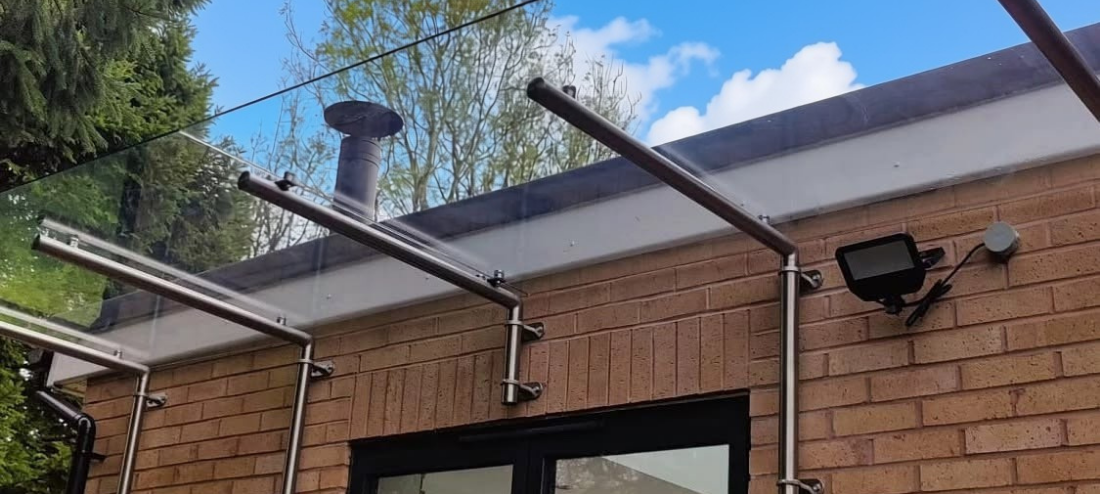
You’ve found a canopy you like. It would smarten up the front of the house, keep the rain off while you hunt for your keys, and it’s hardly a major building job. And then the thought lands, the one that quietly stalls a lot of perfectly simple projects: is this going to need planning permission?
So let’s put your mind at rest straight away, because there’s a decent chance you’re worrying about nothing. For the vast majority of houses, a glass door canopy over the front or back door needs no planning permission at all. In plenty of cases it isn’t even classed as development in the first place. That’s the honest headline, and for most people reading this, it’s the whole answer.
There are, though, four specific situations where that changes, and they catch people out because it’s never the canopy that’s the problem, it’s the property or where it sits. This article walks through when you’re clear to go ahead, when you genuinely do need to apply, and one small piece of paper worth having either way. It’s written for the stage before you’ve spent anything, so you know exactly where you stand.
Why a Canopy Is Usually Fine When a Porch Often Isn’t
Almost all the confusion here comes from one mix-up: people read about porches and assume it applies to canopies. In planning terms, the two are completely different things, and that difference is the key to the whole question.
A porch is an enclosed structure. It has walls, a roof, and usually its own outer door, forming a little lobby in front of your existing entrance. Because it encloses space, it falls under specific permitted development rules (Class D of the planning legislation in England). A porch is only automatically allowed if it stays under three square metres in external ground area, no more than three metres high, with no part within two metres of a boundary that fronts a highway. Break any of those and you have to apply.
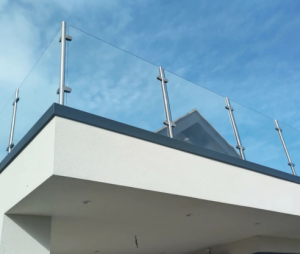
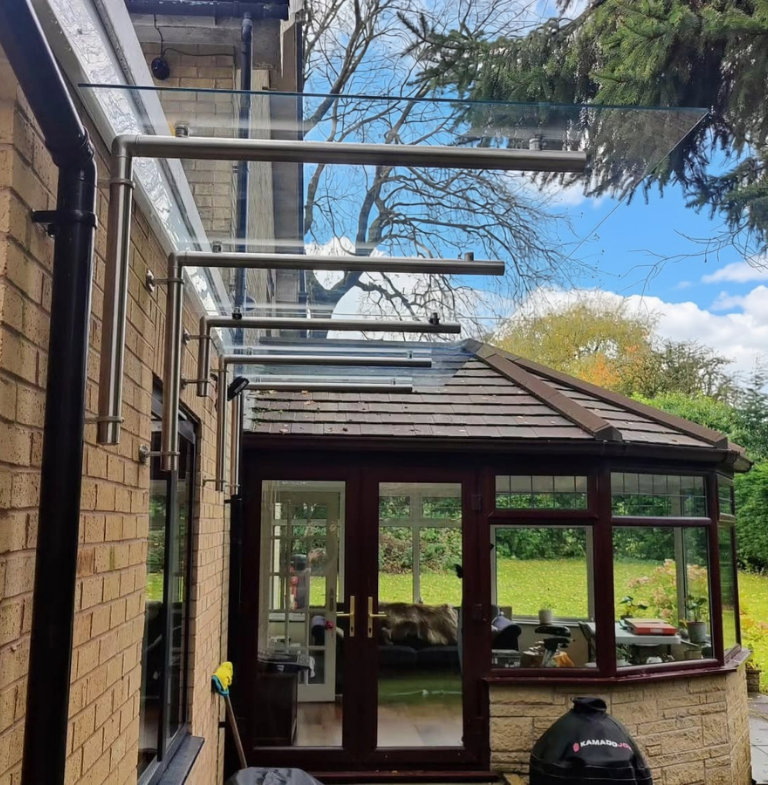
A glass door canopy is a different thing entirely. It’s an open shelter, a projecting roof over the door with no walls closing it in. Because it doesn’t enclose anything, it usually isn’t a “porch” in the planning sense at all, and an open canopy over a door is typically treated as not being development. No walls, no enclosure, no application. That’s why all the porch advice you keep finding doesn’t really speak to your situation.
The takeaway is a reassuring one: if you’re fitting an open glass canopy to an ordinary house, you’re very probably free to go ahead. Now for the handful of cases where that isn’t true.
The Four Situations Where the Answer Becomes Yes
Think of these as a quick checklist. If none of them describes your home, you can almost certainly stop worrying.
-
Your home is a listed building
This is the big one, and there’s no flexibility in it. If your property is listed, you will almost certainly need listed building consent for a canopy, whatever its size, because that consent covers virtually any external alteration to a listed property.
Listed building consent is a separate process from planning permission, and the two aren’t interchangeable. Fitting a canopy to a listed building without consent is a criminal offence rather than just a planning slip, so it’s one to take seriously. The good news is that sympathetic, reversible additions are often looked on favourably. You simply have to go through the process and get it agreed first.
-
You’re in a conservation area or other protected land
Conservation areas, National Parks, and National Landscapes (formerly Areas of Outstanding Natural Beauty) all come with tighter permitted development rights. A canopy that would be waved through on a standard house can need permission here, especially on the elevation facing the street, since the whole point of the designation is protecting how the area looks.
Being in a conservation area doesn’t automatically mean you need permission, but it does mean you can’t assume you don’t. A quick check with your local planning authority settles it.
-
An Article 4 direction applies to your property
This one is easy to miss, because you can’t see it from the street. An Article 4 direction is a tool councils use to remove permitted development rights from a particular area, often part of a conservation area or a street with a character worth protecting. Where one is in place, the usual freedoms don’t apply, and work that would normally be permitted can need a full application.
You won’t know whether one applies without checking, so check. Your local planning authority holds this, and many publish it online by address or postcode.
-
You live in a flat or maisonette
Permitted development rights mostly apply to houses, not flats or maisonettes. If your home is a flat, the freedoms that let a house owner fit a canopy without permission generally don’t reach you, so an application is likely even for something modest. If the building is leasehold, you’ll usually need the freeholder’s consent too, which is a separate matter but just as able to stop a project in its tracks.
Planning Permission Isn’t the Only Box to Tick
Even when you don’t need permission, a canopy still has to be safe and properly built, and two things are worth knowing.
The first is the glass. Any glazing at low level or in a vulnerable spot has to be safety glass under the Building Regulations, which means toughened or laminated glass that breaks safely rather than into dangerous shards. A reputable supplier fits this as standard, but it’s worth confirming rather than assuming, particularly if you’re weighing up a bargain option against a properly specified one.
The second is structural. A glass canopy has to carry wind, and in some parts of the country snow, and it needs fixing into sound structure rather than being screwed to render and hoped for. This isn’t usually a formal Building Regulations sign-off for an open canopy, but it’s the difference between one that stays put for decades and one that works loose in a couple of winters.
How a canopy is specified for wind load varies by location and exposure, which a good supplier will factor in rather than selling you a single one-size product. Our article on how a glass door canopy can transform a plain front elevation covers the design side of getting it right.
The One Piece of Paper Worth Having Either Way
Here’s a bit of advice that isn’t obvious but pays off later. Even when your canopy clearly doesn’t need planning permission, you can apply to your council for a Lawful Development Certificate, a formal written confirmation that your project was lawful and didn’t require permission.
It costs a modest fee and takes a little time, so plenty of people skip it. But it becomes genuinely handy at one particular moment: when you sell. A buyer’s solicitor will sometimes ask for evidence that alterations were lawful, and a certificate answers that instantly instead of holding up a sale while it gets chased. If you’re the cautious sort, or you might move within a few years, it’s cheap peace of mind.
A Quick Check Before You Order
Before committing, run through these:
- Is your property listed? If so, listed building consent is almost certainly required, whatever the canopy’s size.
- Are you in a conservation area, National Park, or National Landscape? If so, check with your local planning authority rather than assuming you’re clear.
- Does an Article 4 direction apply to your street? Your council can tell you.
- Is your home a house, or a flat or maisonette? Flats generally don’t share the same freedoms.
- Is the glass specified as safety glass, and is the canopy designed for the wind exposure where you live?
- Do you want a Lawful Development Certificate for your records, especially if you may sell before long?
A quick word on where you live, since planning is devolved: these rules describe England. Scotland and Wales work to similar thresholds, but confirm locally, and Northern Ireland runs a separate system. Wherever you are, your local planning authority is the last word on your specific address.
The Short Version
For most people fitting a glass door canopy to a normal house, the honest answer is that you don’t need planning permission, and often it isn’t even development. The four things that change that are a listed building, protected land such as a conservation area, an Article 4 direction, and living in a flat. If none of those is you, the odds are you’re free to crack on.
The smartest single move is a five-minute check with your local planning authority before you order. It costs nothing, it removes all doubt, and it means the only thing on your mind when the canopy goes up is how much better the front of the house looks.
Before You Commit
Once you know where you stand and want to talk through the design and specification, take a look at our glass door canopy range, or get in touch with the team. We’re happy to talk through the practical side, including how a canopy should be specified for your property and location, before you commit to anything.
*This article is general guidance on planning in England and not a substitute for advice from your local planning authority. Always confirm the position for your specific property before starting work.*